
Seeing “degeneration” on your X-ray usually means the discs between your vertebrae have lost some height and water over time, often with some bone spurring nearby. Despite the name, degenerative disc disease isn’t really a disease, and it doesn’t automatically mean your back will keep getting worse. What matters most is how those changes line up with your symptoms, and that’s the focus of degenerative disc disease treatment in our Springdale office.
Why “Degeneration” Sounds Worse Than It Is
I’ve had patients walk in holding an imaging report like it’s a bad diagnosis. They read words like “degenerative,” “narrowing,” and “arthritic changes” and picture their spine falling apart.
Here’s the thing. Those words describe normal wear that shows up in most adult spines sooner or later, much like gray hair or wrinkles. Plenty of people with the same findings have no back pain at all. Others have significant pain with only mild changes on film.
So the X-ray is one piece of the puzzle. It isn’t a verdict.
Decoding the Words on Your Report
Radiology reports are written for doctors, not patients. Here’s what a few of the most common terms mean in plain language.
Disc space narrowing
Discs don’t show up directly on an X-ray, but the space they take up between the vertebrae does. When that gap looks smaller than it should, it usually means the disc has lost some height and hydration. This is the finding most people mean when they say “degenerative disc disease.”
Osteophytes (bone spurs)
When a segment of the spine has been under extra stress for a long time, the body sometimes lays down extra bone at the edges of the vertebrae. These small ridges are bone spurs. Many cause no trouble at all, but larger ones can crowd nearby nerves.
Facet arthropathy or spondylosis
The facet joints are small joints at the back of each vertebra that guide how your spine bends and twists. Facet arthropathy means those joints show arthritis. Spondylosis is a broader term for age-related changes in the spine, which is why you’ll often see degenerative joint disease and DDD mentioned together.
Loss of normal curve
Your neck and low back have natural curves. A report may note that a curve looks straightened or reduced. That can come from muscle tension, posture, or past injury, and it’s one more clue we weigh alongside your exam.
Why the Neck and Low Back Show It First
Degenerative changes show up most often in the lower part of the neck and the lower part of the back. Those are the areas that move the most and carry the most load day after day.
Work history plays a role too. In Northwest Arkansas, we see a lot of patients who’ve spent years lifting in warehouses, working production lines, driving long hauls, or sitting at a desk. Repetitive bending, vibration, and long hours in one position all add stress to the same few segments of the spine.
That doesn’t mean your job ruined your back. It just helps explain why certain levels look more worn than others, and it gives us clues about what habits to adjust.
What Your X-Ray Can’t Tell You
An X-ray can’t measure your pain. It can’t show how well your joints move, how your muscles are working, or whether a nerve is irritated.
It also doesn’t show the discs or nerves themselves. If your symptoms suggest a disc pressing on a nerve, such as pain, numbness, or weakness running down an arm or leg, an MRI may be the better test, and I’ll refer you for one when it’s needed.
That’s why the exam matters as much as the film. We look at how you move, where it hurts, and what your reflexes and strength tell us, then compare that to the imaging.
Why We Take X-Rays in Our Office
We have digital X-ray on site, so if imaging is needed, we can usually take it during your first visit and go over it with you right then. You don’t have to wait days for a referral appointment or a phone call with results.
When we review your images together, I’ll point out what’s normal for your age, what may be contributing to your pain, and what probably isn’t. Most patients leave that conversation a lot less worried than when they walked in. You can see how this fits into the process on our first visit page.
What May Help
You can’t turn back the clock on what an X-ray shows. But you can often change how your back feels and how well it works, and that’s the goal.
Keeping the joints moving
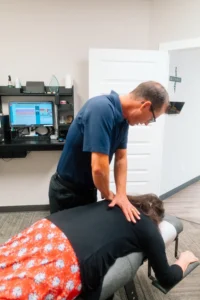
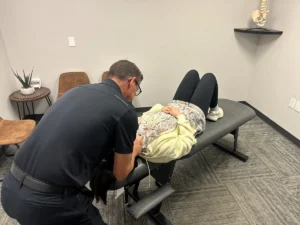
Stiff joints tend to get stiffer, and stiffness can feed pain. Gentle chiropractic adjustments help restore motion to restricted segments of the spine. For patients with significant degeneration, we adapt our technique to keep things comfortable.
Decompression for disc-related pain
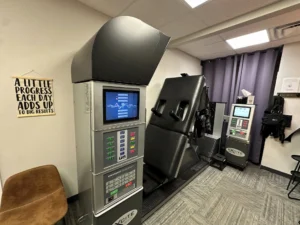
When thinning discs are part of the problem, decompression on the DRX9000 may help take pressure off the disc and nearby nerves. We use it for the low back with lumbar decompression and for the neck with cervical decompression.
Not everyone with DDD is a candidate. Severe osteoporosis, spinal fusion hardware, and a few other conditions can rule it out, and we’ll go over that with you.
Daily habits that add up
Regular walking, staying hydrated, changing positions often, and building core strength all support your spine between visits. If your job involves long hours sitting, driving, or lifting, small changes to how you work can make a real difference.
Setting Realistic Expectations
I’ll be honest with every DDD patient I see. We aren’t going to make your X-ray look 20 years younger. What we’re aiming for is less pain, better movement, and getting you back to the things you’ve been avoiding.
Some patients notice a change within a few visits. Others with long-standing pain take longer, and some do best with periodic care to keep things moving. We’ll talk through a timeline that fits your situation.
Degeneration in the spine is also connected to other conditions we see often, including herniated and bulging discs and spinal stenosis. Our degenerative disc disease page covers more about the condition itself.
When to Get Medical Care Right Away
Most degenerative back and neck pain isn’t an emergency. But see a physician or go to the ER if you have:
- Loss of bladder or bowel control, or numbness in the groin area
- Leg or arm weakness that is getting worse
- Back pain with fever or unexplained weight loss
- Severe pain after a fall or other trauma
Questions Patients Ask About DDD
Will my degenerative disc disease keep getting worse?
Not necessarily. Changes on imaging tend to progress slowly, but many people’s pain levels stay steady or improve with the right care and habits. How you feel and how the X-ray looks don’t always move together.
Should I stop exercising?
Usually not. Movement is one of the best things for a degenerating spine. We may adjust what kind of exercise you do, but cutting out activity altogether often makes stiffness and pain worse.
If an imaging report has you worried about your spine, bring it in and let’s look at it together. Walk-ins are welcome in Springdale, or you can contact us or call 479-756-1155.